Three Ways We Use Artificial Intelligence Today
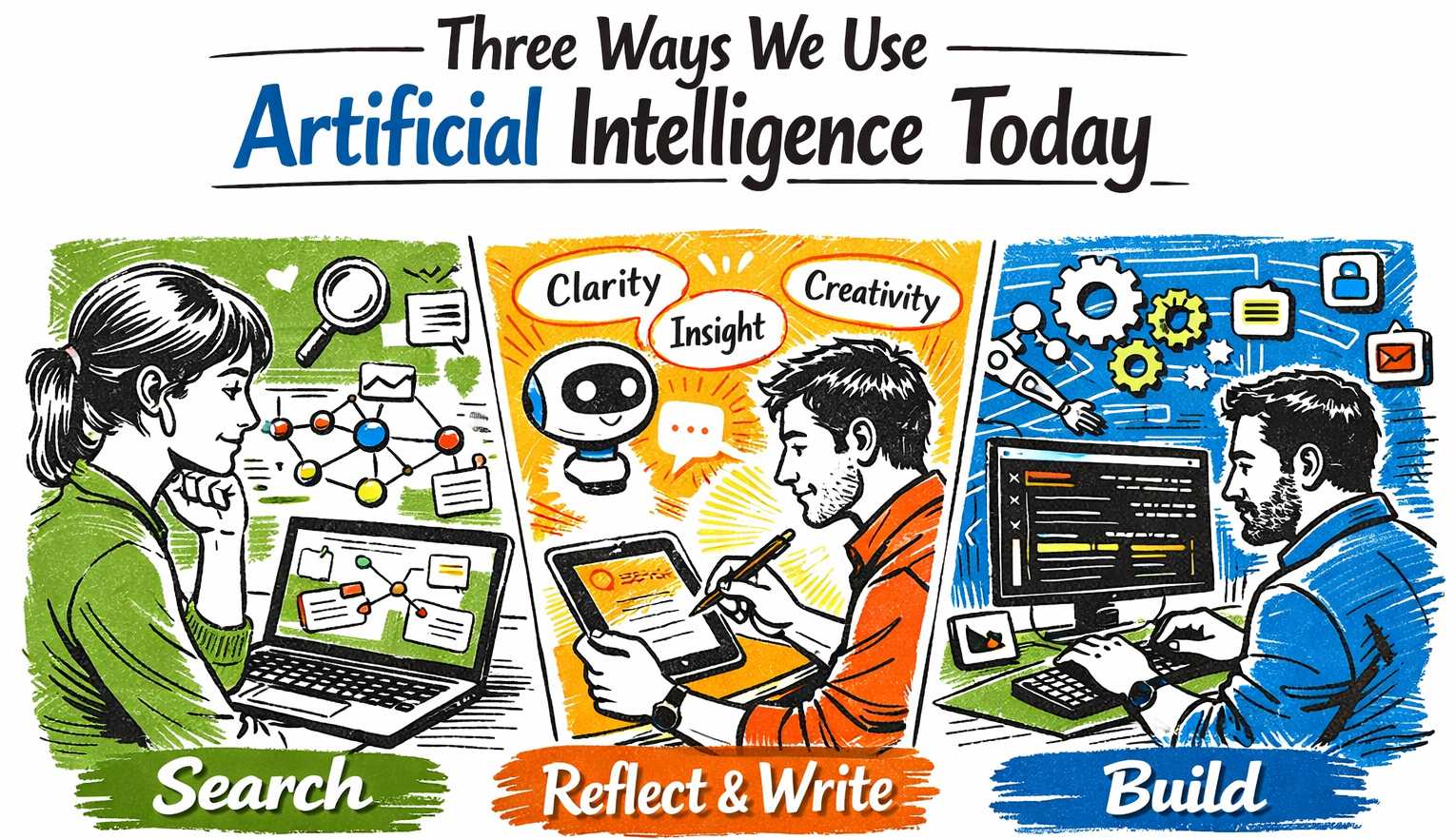
As we've worked with organizations adopting AI, we've noticed a consistent pattern in how people use these tools. Most AI interactions fall into three levels of maturity:
- Search – using AI to discover and synthesize information.
- Reflect & Write – using AI to think, brainstorm, and communicate more effectively.
- Build – using AI to create applications, automate workflows, and solve business problems.
Understanding this hierarchy helps individuals and organizations move beyond simply using AI toward truly working with AI.
1. AI as a Search Engine
The first and most common use of AI is as an intelligent search engine.
Traditional search requires users to navigate multiple websites, compare sources, and assemble information manually.
Modern AI assistants such as ChatGPT, Claude, and Perplexity dramatically reduce this effort by synthesizing information into coherent, conversational responses.
Rather than returning a list of links, AI delivers context, summarizes key concepts, and highlights important relationships between ideas.
Within minutes, you have a well-organized foundation for deeper strategic thinking.
2. AI to Reflect and Write
The second level represents a significant shift.
Here, AI is no longer simply retrieving information—it becomes a thinking partner.
Professionals increasingly use AI to brainstorm ideas, challenge assumptions, organize complex thoughts, refine messaging, and improve communication.
As Ngozi Elobuike highlighted in her TED Talk, AI can dramatically shorten the path from idea to execution by acting as an intelligent brainstorming partner.
3. AI to Build
The highest level of AI adoption is using AI to build.
This is where AI shifts from being an assistant to becoming an engineering partner.
Today, professionals can use AI to:
- Develop applications,
- Automate repetitive workflows,
- Create internal business tools,
- Build data dashboards,
Perhaps most importantly, AI lowers the technical barriers that once separated ideas from execution.
Why it matters
The key advantage is the democratization of innovation.
People no longer need years of programming experience to build useful software.
AI allows subject-matter experts to transform domain knowledge into working solutions faster than ever before.
This changes who gets to innovate.
AI transforms professionals from technology consumers into technology creators.
Moving Up the AI Hierarchy
Most people begin their AI journey by asking questions.
Over time, they discover AI's ability to organize thoughts, improve communication, and enhance creativity.
Eventually, many realize AI can do even more—it can help build the very tools they need to solve problems and create value.
This progression reflects a broader shift in AI maturity:
- Search helps us understand.
- Reflect & Write helps us think.
- Build helps us create.
Each level builds upon the previous one, expanding not only productivity but also what's possible.
References
- ChatGPT - https://chatgpt.com/
- Gemini AI - https://gemini.google.com/
- Manus AI - https://manus.im/app
- Copilot AI - https://copilot.microsoft.com
Written by
Chinegwu Kenechukwu