The Outlook for Generative AI in 2026
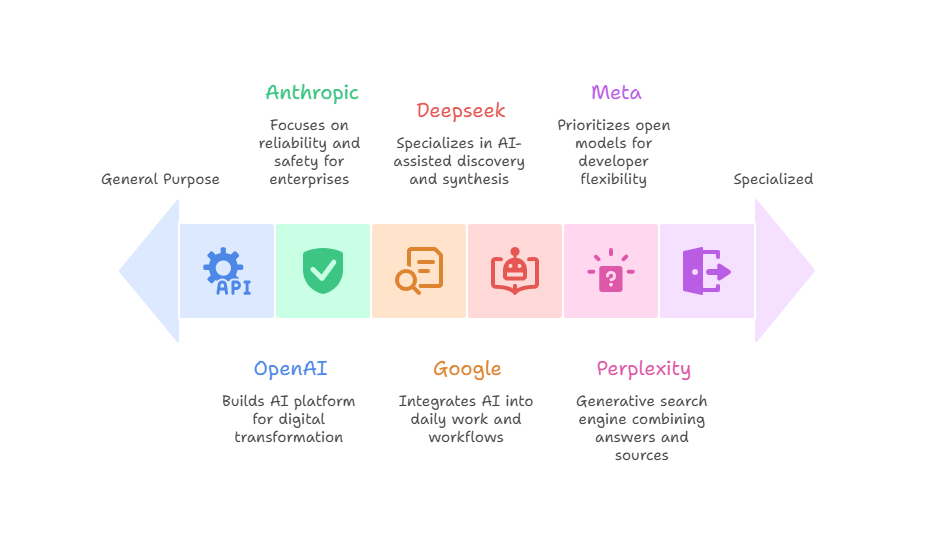
This year, generative AI will no longer feel new or experimental. It will be part of everyday business operations, consumer tools, and digital products across nearly every industry. What started as impressive chatbots is quickly becoming core infrastructure for how work gets done, how people search for information, and how companies scale productivity.
OpenAI
OpenAI remains the market leader. ChatGPT continues to have the largest global user base and a strong enterprise presence. But OpenAI’s real shift is happening behind the scenes. Rather than focusing only on chat, OpenAI is building a full AI platform. Its APIs allow businesses to embed AI directly into their software.
Agentic AI is another major focus, where systems can take action on a user’s behalf, managing tasks like scheduling, customer support, and multi-step workflows. OpenAI is also investing in certifications and ecosystem development to help people and businesses work more effectively with AI. This move positions OpenAI less as a product company and more as a foundation for digital transformation.
Anthropic’s Claude
Anthropic’s Claude models have gained traction by focusing on reliability and safety. This matters most in industries like healthcare, law, and finance, where errors or hallucinations can be costly.
Claude’s “constitutional AI” approach appeals to enterprises that value governance and accuracy over experimentation. By 2026, its growth is likely to come from enterprise contracts, document-heavy workflows like contract review, and partnerships with cloud providers. For companies where trust is non-negotiable, Claude offers a compelling alternative.
Google Gemini: AI Embedded in Daily Work
Google’s Gemini stands out through deep integration. Rather than existing as a standalone tool, Gemini is built into Google Workspace, Android, Search, and Google Cloud.
Gemini also pushes strongly into multimodal AI, meaning it can understand and generate text, images, audio, and real-time context together. This makes it especially powerful for businesses that want AI embedded directly into their workflows. Google’s advantage lies in scale and familiarity. Many organisations will adopt Gemini simply because it fits naturally into tools they already use.
Deepseek and Perplexity
Deepseek and Perplexity focus less on general-purpose chat and more on search and research. Deepseek specialises in AI-assisted discovery, helping users synthesise information from large document sets. This makes it valuable for research-heavy environments like academia, legal work, and enterprise knowledge management.
Perplexity positions itself as a generative search engine, combining conversational answers with sourced information. Its future growth depends on partnerships, new monetisation models, and delivering insights rather than just answers.
Meta
Meta is taking a different path by prioritising open models like LLaMA. This approach appeals to developers and organisations that want flexibility, transparency, and control.
By integrating AI across social platforms and supporting open ecosystems, Meta may attract companies that prefer customisation over closed platforms.
The Bigger Picture
By 2026, generative AI will be standard infrastructure across industries. At the same time, regulations around privacy, data use, and copyright will shape how AI is deployed.
Competition will no longer be about who has the smartest model, but who offers the best ecosystem, trust, and real business value.
Generative AI is maturing, fragmenting, and becoming deeply strategic. The winners will be those who turn powerful models into practical, trusted tools people rely on every day.
References
- Meta AI - https://www.meta.ai/ (Writing Support)
- ChatGPT - https://chatgpt.com/ (Brainstorming)
- Claude AI - https://claude.ai/ (Writing Support)
- NapkinAI - https://www.napkin.ai/ (Image Creation)
Written by
Kenechukwu Chinegwu
Marketing Manager,