AwaDoc Review: A WhatsApp Entry Point Into a More Connected Healthcare Journey
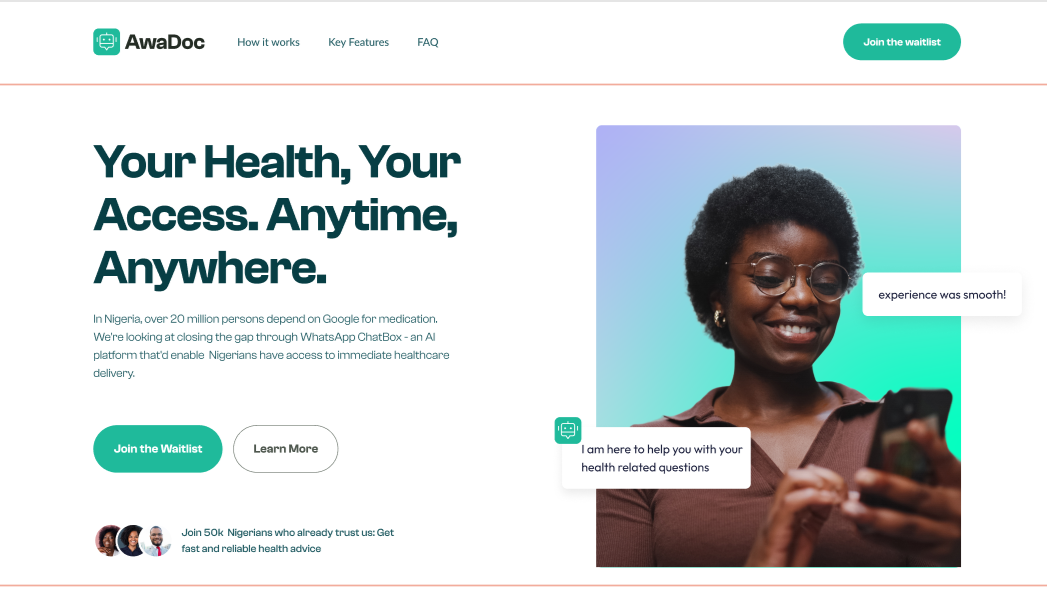
AwaDoc is built around a familiar reality in Nigeria: when a health question comes up, many people reach for their phone before going to a clinic. It aims to make that first step more useful.
Through a WhatsApp assistant, users can describe symptoms, ask health questions, and get guidance on what to do next.
The company is also developing a broader digital-health platform for providers and organizations that connects symptom checks, consultations, laboratory support, and follow-up care.
That combination gives AwaDoc a clear proposition. It is not simply a chatbot answering questions. The larger ambition is to make healthcare easier to navigate, while using conversation as a practical front door.
From a question to a next step
AwaDoc has a straightforward user journey: register, open WhatsApp, and ask the assistant about symptoms, medications, or other health concerns.
Users can also upload photos and medical documents, including test results, for context. The company says its assistant, Noura, can provide general health information and recommendations, while its platform can connect users with clinicians and services such as consultations and lab support.
This matters because access is not only about finding information. People also need to know whether a concern can wait, whether to speak with a clinician, and where to go next.
A conversational interface can reduce the effort of starting that process. WhatsApp is already familiar to many users, so it creates less friction than asking people to download and learn another standalone app.AwaDoc also describes capabilities beyond the consumer assistant, including AI triage, emergency red-flag detection, medication reminders, and care-pathway automation. If these functions are implemented reliably and connected to responsive care providers, they could make the experience more continuous than a one-off symptom checker.
The platform’s own description focuses on coordinating people, providers, and health services rather than replacing existing systems.
The opportunity is significant, but the boundary is crucial.
Health guidance carries higher stakes than general-purpose AI answers. A useful assistant must do more than sound confident. It must identify high uncertainty, recognize warning signs, and direct people to qualified care without offering false reassurance.
AwaDoc says it is not a substitute for professional medical advice, diagnosis, or treatment, and that it is not designed for emergencies. Those are important boundaries, not fine print to ignore.In practice, users should treat AwaDoc as a way to get oriented, not as a final authority on what is wrong or which treatment to take. The company itself advises people to verify critical information with a medical professional and to seek emergency care for urgent situations.
That distinction is central to evaluating any AI health product: the best outcome is not simply a fast answer, but a safer next decision.
The company says its services comply with HIPAA, GDPR, and Nigeria’s NDPR, and that it encrypts and securely stores personal information. These are meaningful claims, but people and organizations should review the applicable privacy terms and data-handling details for their own use case. Health information is sensitive, and the practical question is how it is collected, retained, accessed, and shared across the care journey.
Who is AwaDoc for?
For individuals, AwaDoc may be most useful when someone wants an accessible starting point for a non-emergency health question or needs help navigating available care.
For providers and health organizations, the more strategic proposition is infrastructure: AwaDoc says it offers APIs and integrations for symptom checks, virtual consultations, labs, and follow-ups. That could be relevant to teams trying to connect fragmented steps without building every digital component themselves.
The fit will depend on execution. For consumers, trust rests on clear guidance, dependable escalation, and a smooth handoff to human care. For institutions, it will depend on integration quality, service coverage, privacy practices, and evidence that the workflow improves access or reduces avoidable delays.
Those are the areas to assess in a pilot, rather than assuming that AI alone produces better outcomes.
Our take
AwaDoc is tackling a meaningful problem with a channel people already know. Its strongest idea is combining conversational access with care navigation, backed by a broader ambition to connect services across the patient journey. That gives it more potential than a standalone symptom checker.
The opportunity comes with a clear responsibility. In healthcare, helpful technology must know its limits and make human care easier to reach. AwaDoc’s public materials acknowledge that boundary. The next test is how consistently its product, clinical workflows, and service partners deliver on it in real-world use.
For organizations exploring digital-health tools, AwaDoc is worth evaluating as a care-coordination layer, especially where WhatsApp access and connected workflows fit the population being served. For individuals, it can be a useful first conversation, provided it is treated as guidance rather than diagnosis—Our Agentlyst editorial score: 4.3/5.