AI is accelerating rapidly, and governance must keep pace: Notes from India’s AI Summit
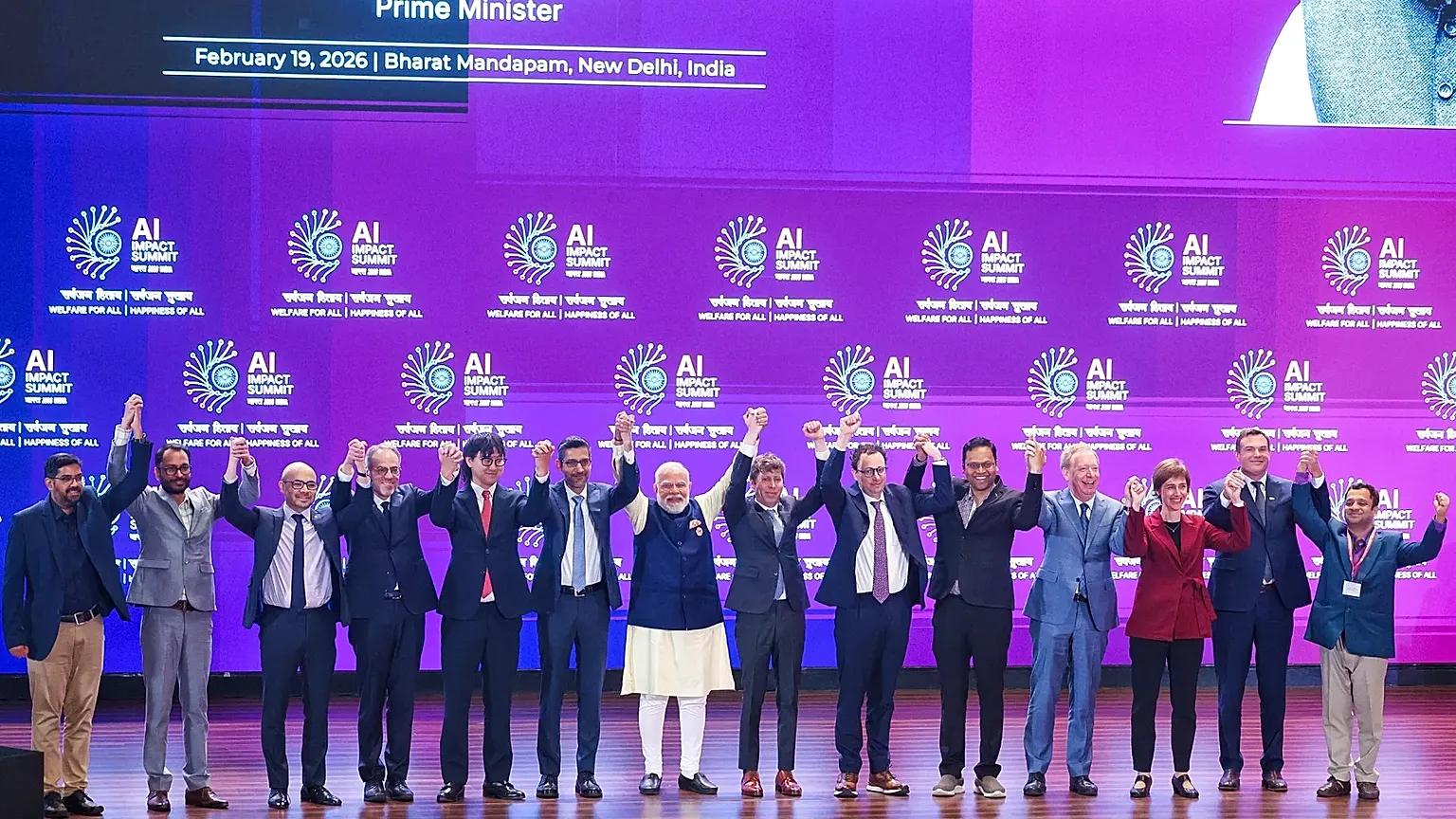
The India AI Impact Summit 2026 in New Delhi is emerging as one of the most consequential artificial intelligence gatherings of the year.
This summit feels less like a tech showcase and more like a strategic forum on how intelligence itself will be governed, deployed, and scaled in the coming decade. Policymakers, founders, researchers, and global executives are grappling with a shared understanding.
OpenAI represented in Person by Sam Altman
Among the global figures present, Sam Altman, Chief Executive Officer of OpenAI, became one of the most closely watched voices at the summit.Altman highlighted India’s growing centrality in the AI ecosystem, noting that over 100 million people in the country use ChatGPT weekly.
That scale, combined with India’s democratic framework and robust developer base, positions it not merely as a consumer of AI, but as a co-architect of its future.
One of the most discussed moments came when Altman suggested that early forms of superintelligence could emerge within the next few years. He went further, predicting that by the end of 2028, more of the world’s intellectual capacity could reside inside data centers than outside them. He also emphasized the importance of global cooperation and shared safety standards.
AI leadership, he implied, is no longer geographically concentrated. It is becoming distributed, collaborative, and increasingly shaped by countries with diverse economic and social priorities.
The Substance Behind the Summit
While personalities draw attention, the summit’s true significance lies in the themes dominating its discussions.Responsible AI governance has been a consistent focus.
Panels explored fairness, transparency, bias mitigation, and accountability frameworks. There is growing agreement that the power of AI systems demands equally robust safeguards.
Data sovereignty and infrastructure also featured prominently. As AI becomes foundational to national competitiveness, countries are reassessing how data should be stored, protected, and leveraged. Investment in national compute infrastructure is now seen not as optional, but strategic.
India’s vision of “AI for All” was another defining thread. Discussions highlighted multilingual AI systems reflecting the country’s linguistic diversity, machine learning models supporting agriculture and climate resilience, and AI-powered education tools designed to reach underserved communities.
The emphasis was clear: AI should expand opportunity, not concentrate it.
What's Next?
India’s Global AI Summit signals something important.
The future of intelligence is not being revealed in a single breakthrough moment. It is being shaped collectively — at the intersection of policy, infrastructure, research, and global collaboration.
And that collaborative shaping may prove to be the most significant development of all.
References
- Gemini AI - gemini.google.com (Writing Support)
- ChatGPT - chatgpt.com (Writing Support)
- Copilot AI - copilot.microsoft.com (Writing Support)
Written by
Kenechukwu Chinegwu
For Zeta-AI.