Abridge Review: Can Ambient AI Give Clinicians More Time With Patients?
Abridge Review: Can Ambient AI Give Clinicians More Time With Patients?
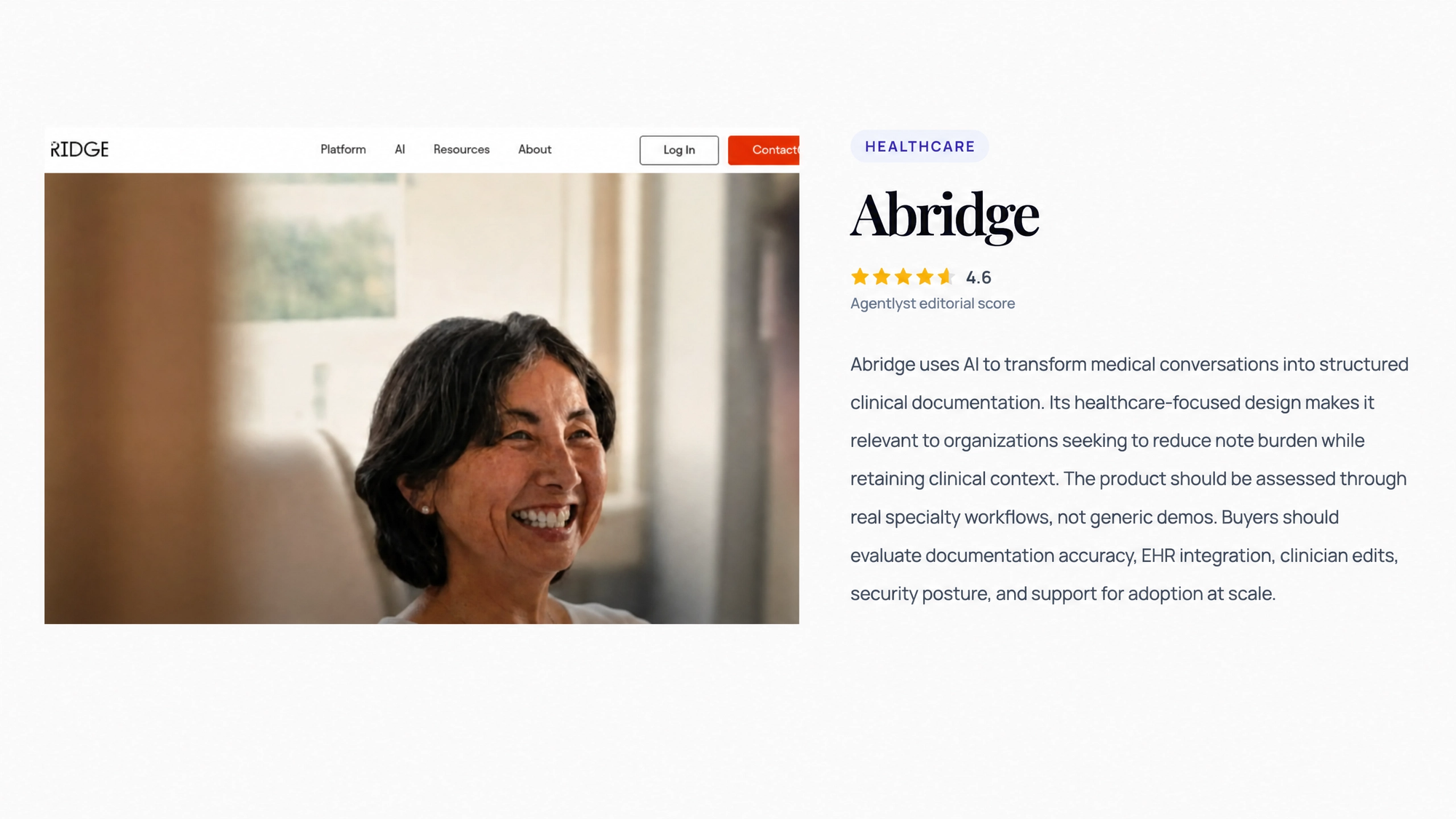
Abridge is an artificial intelligence platform designed to transform medical conversations into structured clinical documentation. In simple terms, it listens to the patient–clinician interaction, identifies the important clinical context, and helps produce a usable note for the electronic health record (EHR). That sounds straightforward, but healthcare documentation is not a simple transcription problem. A useful clinical note needs to preserve meaning, distinguish symptoms from diagnoses, capture relevant history, and fit into a clinician’s existing workflow. This is why Abridge is interesting: it is focused less on generic voice-to-text and more on the complete documentation process.
What is Abridge?
Abridge is an enterprise-grade AI platform for clinical conversations. Its stated purpose is to help healthcare organizations create clinically useful and billable notes at the point of care, with the output integrated directly into EHR workflows. The platform is built around the idea of reducing documentation burden without removing the clinician from the process. The clinician still reviews, edits, and approves the note. Abridge’s role is to reduce the amount of manual writing and administrative effort required after the conversation. This distinction matters. The best use of AI in healthcare is not to replace clinical judgment. It is to give clinicians better tools for capturing information, reviewing evidence, and spending more attention on the patient in front of them.
How Abridge works in practice
A typical workflow begins during the patient encounter. Abridge captures the conversation and processes it using its Contextual Reasoning Engine. It then generates a draft note that the clinician can review and refine.Abridge’s official product page highlights its integration with Epic. Clinicians can capture conversations in Haiku, review AI-generated drafts in Hyperspace, and use Linked Evidence to connect parts of the note to the underlying conversation.The workflow is therefore more than “record, transcribe, copy.” It is designed to connect the conversation, the generated documentation, and the EHR environment. That connection is one of the reasons Abridge is positioned primarily for health systems rather than casual individual use.
Key features of Abridge
1. Ambient clinical documentation
The central feature is ambient documentation. Instead of requiring the clinician to type continuously or dictate a note from memory, Abridge helps capture the encounter in the background and turns it into structured documentation. For clinicians, the potential benefit is obvious: less time spent looking at a screen and more time maintaining a natural conversation with the patient. It may also reduce the amount of documentation that must be completed after clinic hours.
2. Context-aware note generation
Medical conversations contain interruptions, shorthand, questions, corrections, and details that are only meaningful in context. Abridge is designed to interpret the conversation and organize it into a clinical note rather than returning a raw transcript. This is an important difference between a general transcription tool and a healthcare-focused AI system. The objective is not to capture every word equally. The objective is to produce documentation that is relevant, readable, and useful inside the clinical workflow.
3. Linked Evidence
Abridge’s Linked Evidence feature is particularly valuable because it supports verification. Clinicians can review the evidence behind sections of an AI-generated note instead of accepting the output blindly. This creates a more responsible human-in-the-loop workflow. The AI drafts. The clinician checks. The final note remains under professional control.
4. EHR integration
Abridge’s Epic workflow is a major part of its enterprise appeal. The company describes support for capturing conversations in Haiku and reviewing drafts in Hyperspace, which can reduce the need to move information manually between disconnected tools. However, integration should always be tested in the specific environment where the product will be used. An integration that works well in one health system may still require configuration, governance, training, or workflow changes in another.
5. Enterprise governance and security controls
The product page lists capabilities including single sign-on, custom governance controls, analytics and reporting, HIPAA compliance, secure cloud infrastructure, and encrypted data. These features are important for health systems, but they should not be treated as a substitute for due diligence. Buyers should review the business associate agreement, data-retention policies, access controls, audit processes, model governance, and incident-response procedures before deployment.
Why Abridge could be useful
The strongest case for Abridge is the documentation burden experienced by clinicians. When a clinician spends less time writing notes, the organization may be able to improve the patient experience, reduce after-hours administrative work, and support more sustainable clinical practice. Abridge’s official website highlights outcomes reported by health-system customers, including reductions in cognitive load and documentation effort. These figures are encouraging, but they should be treated as customer-reported results rather than a guarantee. A healthcare organization should run a structured pilot and measure its own outcomes
Abridge pricing
Abridge does not publish a standard public price or self-serve checkout. The platform is sold primarily through negotiated enterprise contracts with healthcare organizations. One independent review cites an estimated enterprise license of approximately $2,500 per clinician per year, or about $208 per month, while noting that full implementation costs can vary depending on integration depth and contract terms. This figure is not an official Abridge list price, so it should be used only as an initial budgeting reference.
Limitations to consider
Abridge is not the obvious choice for every healthcare professional. Its enterprise orientation may make it less suitable for an individual clinician or small practice looking for an inexpensive tool that can be activated immediately. The quality of the final note will also depend on the specialty, the complexity of the encounter, audio quality, clinician workflow, and the effectiveness of the review process. AI-generated documentation can contain omissions or inaccuracies, so clinicians must continue to verify the output before signing.
Our Verdict
Abridge is one of the more compelling examples of AI being applied to a specific professional problem rather than marketed as a general-purpose assistant. Its value comes from connecting ambient conversation capture, contextual note generation, evidence review, and EHR integration. The platform appears best suited to hospitals, health systems, and larger provider organizations that can support enterprise implementation and measure outcomes carefully. For those organizations, the main question is not whether AI can write a note. It is whether the complete workflow can help clinicians document accurately while preserving attention for the patient. AI is most valuable when it removes friction from important work without removing human responsibility. For healthcare organizations that can answer those questions with evidence, Abridge could become more than an AI scribe. It could become an intelligence layer that helps clinicians spend less time documenting and more time caring. Visit Abrige